Another proposal to crack down on fraud in Minnesota has stalled at the State Capitol.
DFL Representative Matt Norris says Republicans blocked his bill in a House committee that would expand the Attorney General’s fraud unit, with the federal government covering most of the cost.
The plan would add 11 investigators and three prosecutors to the office to target fraud in programs like Medical Assistance, where recent high-profile cases and audits have intensified pressure on lawmakers to act. Norris says the vote sends mixed signals:
The proposal relies on federal funding to pay roughly 75 percent of the staffing costs. Republicans pushed for an alternative funding amendment, but that also failed. Norris says the effort isn’t over:
Lawmakers in both parties agree Minnesota has a major fraud problem, but remain divided on how to fix it.
Congress has voted to overturn a 20-year mining withdrawal in northern Minnesota’s Superior National Forest, opening the door for the proposed Twin Metals copper-nickel mine near the Boundary Waters Canoe Area Wilderness, a federally protected wilderness that sits within one of the largest intact freshwater systems in the United States.
The Senate narrowly approved the measure and sent it to Donald Trump, who is expected to sign it. The project is owned by Chilean mining giant Antofagasta.
DFL Senator Jen McEwen says the fight now shifts to state leaders.
Supporters say the vote protects jobs and the Iron Range economy. Republican Congressman Pete Stauber called it a major victory, saying the bill reverses what he calls an illegal mining ban. Republican State Senator Robert Farnsworth praised the decision, calling mining a storied legacy passed down through generations.
But opponents warn the stakes are exceptionally high. The Boundary Waters is the most visited wilderness area in the country and sits atop a vast interconnected watershed that flows into the Rainy River Basin and beyond. Environmental groups say copper-nickel mining poses a unique risk because the sulfide ore can create sulfuric acid when exposed to air and water, potentially leaching heavy metals into lakes and rivers. They argue contamination could spread through hundreds of miles of interconnected waterways and be nearly impossible to clean up once it begins.
Democrats and environmental advocates also warn the minerals could ultimately be shipped overseas for processing, raising concerns the environmental risks would remain in Minnesota while the economic benefits could leave the country.
The issue now shifts to state regulators and a growing political battle over the future of mining near the Boundary Waters.
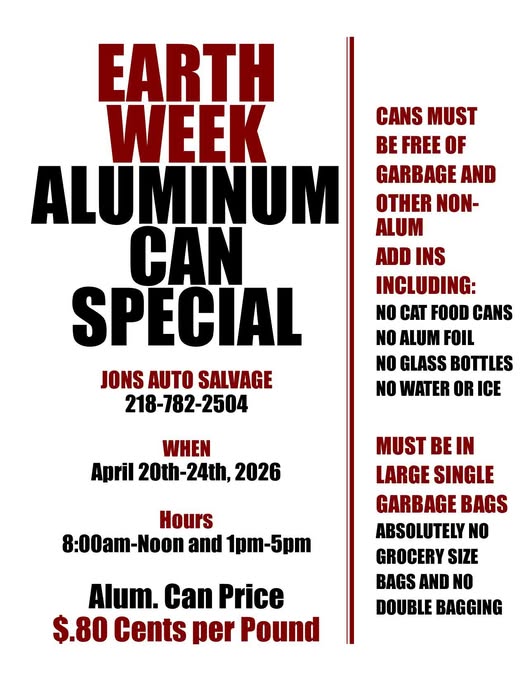
Jon’s Auto Salvage of Greenbush is marking Earth Week with a special push for recycling. From April 20th through the 24th, the business will pay 80 cents per pound for aluminum cans. Hours run from 8 a.m. to noon and 1 p.m. to 5 p.m. daily. Organizers say all cans must be clean and free of non-aluminum materials. Items like foil, glass, and food waste won’t be accepted. Participants are also asked to bring cans in large single garbage bags only.