






By Mani Souphom – R & J Broadcasting, Inc. | Wednesday, October 14, 2026
WARROAD, Minn. — Candidates seeking state and local offices discussed rural health care, property taxes, government spending, public safety and education during a candidate forum hosted by Warroad Community Development on Tuesday, Oct. 13, ahead of the Nov. 3 general election.
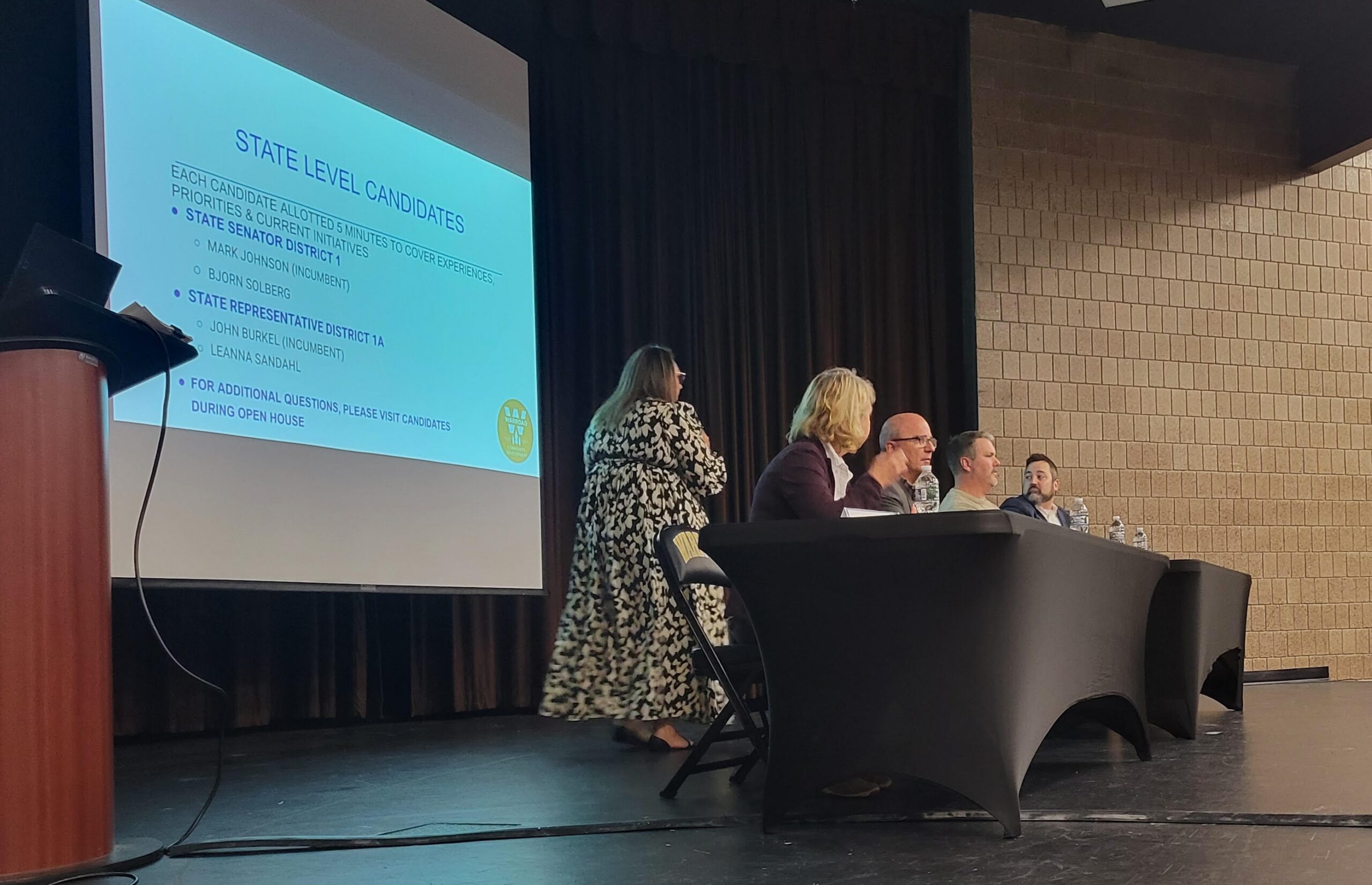
Warroad Community Development Executive Director Sarah Carling organized the event, which featured candidates from Minnesota Senate District 1, Minnesota House District 1A, Roseau County government, the city of Warroad and the Warroad School Board. Brian Mayfield moderated the forum and kept time for candidates’ responses.
Carling shared a message for the candidates who participated in Tuesday night’s forum.
Carling also discussed what she hoped local residents would gain from hearing directly from the candidates.
For residents who could not attend, Carling said the forum had been recorded and would be made available online.
Carling also commented on the turnout for the event.
Residents can find information about upcoming Warroad Community Development events online at the nonprofit’s website and on their facebook page.
State Senate District 1
Republican incumbent Mark Johnson and DFL candidate Bjorn Sjoberg discussed rural health care, education, government spending and the importance of ensuring northwestern Minnesota has a strong voice in St. Paul.
Bjorn Sjoberg
Sjoberg opened by thanking residents for attending and Warroad Community Development for organizing the forum. He said he wanted to share his background and vision for representing Senate District 1.
Sjoberg grew up in a family with 155 years of farming roots south of Fargo. He moved to Halstad about 10 years ago after identifying an opportunity to purchase a business while in his mid-20s. He said the move gave him a chance to become part of a small community while working to address issues affecting rural residents.
His interest in rural economic challenges is rooted in his family’s experience. In the late 1990s, he said, his father had to reduce his farming operation, take a second job in town and eventually retire from farming. Sjoberg said he wants to address the pressures that make it difficult for family farms to remain viable.
He also described his family’s experience navigating the health care system after his mother was seriously injured in a car accident when he was 10. The injury brought financial stress and challenges in getting bills paid and procedures approved, he said.
Sjoberg said he wants to help ensure rural hospitals have the funding necessary to remain open and provide services close to home, particularly as federal funding changes put additional pressure on rural facilities.
He holds a degree in sociology and said he originally planned to become a teacher and basketball coach. His education shaped his understanding of how institutions work together and how limited resources can affect teachers and students.
Sjoberg said childcare, health care, education and emergency services all need stronger support and additional resources. He also emphasized that rural communities need an advocate in the state Capitol who will prioritize their needs rather than simply follow party leadership.
He said his approach would be to fight for constituents regardless of whether that meant disagreeing with the president, Democrats or Republicans.
Mark Johnson
Johnson, the Republican incumbent, thanked Carling and Warroad Community Development for organizing the forum, noting the work required to bring candidates together and create an opportunity for civic discussion.
Johnson said he has served the region for 10 years and is a fifth-generation northwestern Minnesotan raising his children in the area. He said he was proud to represent the region and wanted to help preserve its quality of life for future generations.
Johnson discussed challenges rural nursing homes faced during the COVID-19 pandemic, particularly staffing shortages and efforts to keep facilities operating while protecting residents and employees.
He said he contacted the Minnesota Department of Human Services (DHS) about emergency staffing assistance for nursing homes. According to Johnson, DHS told him that some facilities were too far into rural areas for the state agency to help.
Johnson said he and Rep. John Burkel worked to push back against that response and advocate for nursing homes and other institutions in northwestern Minnesota. He said residents in the region pay taxes and deserve access to services and support comparable to, if not greater than, those available elsewhere in Minnesota.
Johnson cited $254 million in cost savings on temporary vehicle tabs legislation and $300 million in support for nursing homes as examples of efforts to address financial pressures on the state and rural institutions. He said more could still be done to support schools and colleges.
Johnson also said becoming Senate minority leader was partly motivated by a desire to ensure northwestern Minnesota had a stronger voice in St. Paul. He said he intended to continue advocating for the region and its institutions.
Minnesota House of Representatives, District 1A
Republican incumbent John Burkel and DFL candidate Leeanna Sandahl discussed rural health care, insurance costs, taxes, government accountability and the value of cooperation across party lines.
Leeanna Sandahl
Sandahl thanked the organizers and attendees, saying the turnout demonstrated that residents were interested in participating in local civic discussions. She said she had heard people suggest that it was difficult to find candidates for public office, but the number of people attending and participating in the forum showed otherwise.
Sandahl grew up in Kittson County, east of Lake Bronson, and lives in Pennington County, east of Thief River Falls. She works at Digi-Key and owns a small business as a graphic artist and sign maker.
She acknowledged that she does not have the same background in legislative work, policymaking or government as some candidates. However, she said running a small business has taught her the importance of listening carefully to people, understanding their needs and delivering a product that meets their expectations.
Sandahl said she believes those skills also apply to public service. Representatives must listen to constituents, understand what matters to them and work toward practical results, she said.
She added that accomplishing goals sometimes requires working across the aisle and compromising. If elected, she said she would aim to encourage a political environment in which people can discuss disagreements, work together and find common ground.
John Burkel
Burkel thanked Warroad Community Development for the opportunity to speak and said he appreciated representing northwestern Minnesota in St. Paul.
He said many challenges facing rural communities do not fit neatly into the categories commonly discussed at the Capitol. Residents want affordable health care, good schools and opportunities to make a living, he said, and they understand the difference between increasing spending and actually solving a problem.
Burkel discussed the financial challenges facing rural hospitals and nursing homes, including reimbursement rates. He explained that Medicare is a federal program, while Minnesota also makes decisions affecting how health care providers are reimbursed. Those decisions can have significant consequences for rural facilities and the communities that depend on them.
He also discussed Minnesota’s reinsurance program, which helps cover certain high-cost insurance claims in the individual health insurance market. Burkel said the program helps stabilize the market and makes coverage more affordable. He cited estimates that premiums were about 20% lower than they otherwise would have been because of the program.
Burkel said the closely divided Legislature, with a 67-67 tie in the House, required lawmakers to work across party lines. He said there was value in finding areas of agreement rather than allowing either party to dictate the outcome.
He criticized state spending increases and mandates that he said put additional pressure on counties, schools and local taxpayers. Burkel also called for property tax relief, including temporary relief through vehicle registration taxes, and said Minnesota residents had a right to expect accountability for public spending.
Burkel highlighted the creation of the state Office of Inspector General as an important step in addressing fraud and oversight concerns. He said taxpayers should have confidence that money sent to St. Paul is being spent appropriately.
Roseau County commissioner
Candidates Laura Larson and Shane Horner discussed their backgrounds, budget priorities, property taxes, infrastructure and the responsibilities of representing residents at the county level.
Shane Horner
Horner said the county commissioner position had been part of his family’s history. His great-uncle served as a commissioner for 28 years, and his father later held the position until his death. Horner said his father’s service helped spark his own interest in the role.
A fifth-generation Warroad resident, Horner said he hopes to help maintain the community as a place where his children and future generations can build their lives. He also cited his Christian faith and a desire to serve his neighbors as motivations for running.
Horner works in manufacturing engineering at Marvin Windows. He said his job requires him to communicate with employees and management, identify problems, develop plans with stakeholders and meet budget and deadline requirements.
He said those experiences could translate to county government, where decisions require coordination among people with different needs and priorities.
Horner said he would approach county spending cautiously, particularly given economic pressures and tight budgets. He identified roads and other infrastructure, public safety and emergency services as priorities.
He also emphasized the importance of supporting agriculture, manufacturing and small businesses. Those industries provide jobs that help residents remain in the region and maintain a good quality of life, he said.
Asked about the county’s biggest challenges, Horner said he did not want to offer a list of solutions before gaining a fuller understanding of the job. He said the cost of living was a concern he repeatedly heard from residents and that the county would need to make difficult spending decisions while carefully considering the effects on taxpayers.
In his closing remarks, Horner thanked residents for attending and said he would approach the position with hard work and a commitment to treating people with honesty, dignity and respect.
Laura Larson
Larson said conversations with residents have been a major source of motivation for her campaign. She described her campaign of knocking on doors and getting to know people in their homes, saying the community and its residents have inspired her work.
Another fifth-generation member of a Warroad family, Larson said working at the local newspaper for three summers helped her learn about residents’ stories, values and work ethic. She said she wants to put her experience and passion for serving others to work on the county’s behalf.
Larson has worked at the state Capitol on issues involving local government, broadband, transportation, human services and public safety. She said serving as a rural point person gave her experience with policy, budgets and relationships that could help her get answers and advocate for residents.
She highlighted work involving rural emergency services and ambulance funding, as well as efforts to work with community members and townships to oppose proposals she believed threatened farmers, homeowners and local ways of life.
Larson said she could use her knowledge of the legislative process and relationships with people across the state to help the county address problems. She also described volunteering with the RiverPlace organization and participating in veterans-related activities.
On county spending, Larson said residents across income levels were concerned about affordability and the possibility of being unable to remain in their homes because of rising costs. She said county leaders should examine budgets line by line, carefully consider proposed spending and avoid adding to residents’ financial burdens while maintaining essential services.
Larson identified property taxes and affordability as key concerns, along with road and ditch maintenance. She said maintaining roads and keeping ditches clear are important to preventing flooding and addressing problems before they worsen.
She also emphasized constituent service, saying commissioners need to respond to residents’ concerns, help them find the right contacts and follow through when issues arise.
Larson said she hoped to reach as many residents as possible before Nov. 3 and would appreciate the opportunity to serve the community.
Roseau County sheriff
Incumbent Sheriff Steve Gust and challenger Adam Krasprowicz discussed their law enforcement experience, department budgets, firearm rights, cooperation with federal immigration authorities and public safety challenges.
Adam Krasprowicz
Krasprowicz cited experience in emergency medical services, law enforcement, corrections, firearm safety education and community volunteering as preparation for the sheriff’s office.
He said he had worked in corrections at the Tri-County Community Corrections facility, which housed roughly 30 to 40 inmates, and had experience as an emergency medical technician. He also described community involvement in Roseau County, work with students, including robotics at Thief River Falls High School.
Krasprowicz said his experience has helped him develop skills in emergency response, problem-solving, training, communication and working with people experiencing mental health challenges.
If elected, he said he would emphasize transparency, staff wellness, professional standards and community outreach. He also said he wanted to improve support for crime victims and encourage residents to report sexual assault, domestic violence and child abuse.
On the department budget, Krasprowicz said staffing, benefits, education and training would be priorities. He noted that law enforcement technology, jail operations, medical care, food, facility maintenance and dispatch systems can be expensive.
He said the department should review spending regularly, distinguish between necessary expenses and wants, and seek grants and other funding opportunities when possible. At the same time, he cautioned that cutting necessary technology or training could leave the department behind.
Krasprowicz said he supports the Second Amendment but believes law enforcement must use due process when responding to threats involving firearms. He said extreme risk protection orders should be used when the evidence supports them and legal requirements are met.
He also said law enforcement should take reports of abuse and violence seriously, investigate thoroughly and work to prevent harm when warning signs emerge. Mental health training and helping people navigate available services would be important parts of that effort, he said.
Regarding federal immigration enforcement, Krasprowicz said local law enforcement has many responsibilities of its own but can assist agencies such as Border Patrol and Customs when appropriate. He said cooperation can benefit both local and federal authorities, including through Stonegarden grants.
Krasprowicz identified underreporting of sexual assault, domestic violence and child abuse as a major public safety concern. He said people may be afraid to report crimes or unsure how to seek help, and delays can make it harder to gather evidence.
He also pointed to mental health crises as an ongoing challenge, saying officers need training to recognize situations and help connect people with appropriate services.
In his closing remarks, Krasprowicz said he was committed to Roseau County, where he was born and raised, and wanted to continue serving the community.
Steve Gust
Gust said concerns about how people were treated in law enforcement more than 20 years ago helped motivate him to pursue a more community-oriented approach to policing. He said his experience in business and law enforcement had shaped how he evaluates the department and its operations.
Gust, who has served as sheriff for 16 years, said he reviews the department’s budget line by line each year and looks for grants to offset costs. He discussed Stonegarden grants, which have helped support cooperation with Border Patrol, and the county’s drug task force.
He said grant funding helped the department expand drug task force work while reducing the county’s share of the cost. He also emphasized the importance of training and working with other agencies to address public safety concerns.
Gust said public safety remains the department’s top priority, but he believes the department should continue to evaluate its spending and consider whether changes can be made without compromising its work.
On firearm rights, Gust said he supports the Second Amendment and believes firearm safety education should begin when children are young. He described growing up around guns and learning how to handle them safely, and said parents and schools can help children understand the dangers and responsibilities involved.
Gust said mental health resources remain inadequate in the region. When someone is experiencing a crisis and may be a danger to themselves or others, law enforcement sometimes has few options beyond taking the person to jail, he said, even though jail is not an appropriate long-term solution for mental health care.
He also discussed the connection between substance use and mental health, saying the drug task force remains important for holding people accountable and addressing drug-related crime.
Gust said local law enforcement works alongside Border Patrol and supports cooperation between agencies, including through Stonegarden.
In his closing remarks, Gust thanked residents for the opportunity to serve as sheriff. He said the department has capable employees who could lead in the future and that he wants to support the next generation of law enforcement leaders.
Warroad mayor
Tom Goldsmith
Goldsmith, who is running unopposed, submitted a recorded statement due to a scheduling conflict. He said he believes in Warroad’s future and has focused on putting residents first during his time as mayor.
Goldsmith said local businesses are essential to the community and that Warroad’s natural resources create opportunities to attract residents, visitors, investors and jobs.
He highlighted planning and development work involving the marina, boat ramp, parking and paved access. He said the improvements are intended to provide a safe and practical lakefront area for residents while strengthening tourism. Planning and funding work has also begun for a later phase of camping and park access, he said.
Housing was another major priority. Goldsmith thanked residents who participated in a housing survey and open house, saying the city planned to identify the types of housing Warroad needs, potential locations for growth, necessary utility and street improvements, and partnerships that could make projects financially achievable.
He also described a strengthened partnership with Warroad Community Development, which he said has helped support housing efforts, community engagement, marketing and future park planning. Other examples of collaboration included a community website, kiosks, broader outreach and a sidewalk project extending south from the river toward the school.
Goldsmith pointed to a lease involving a solar field on about 250 acres near the lagoons as another way to generate revenue outside the property tax levy.
Looking ahead, he said he wants the city to complete projects already underway while maintaining financial discipline and pursuing grants and other funding that benefit residents and visitors. He also identified the Highway 11 and Lake Street intersection as an issue requiring a safe, practical resolution.
Goldsmith said future energy and economic development opportunities should be pursued when they offer clear, lasting value to Warroad. He added that the city’s direction should reflect the input of residents, businesses, volunteers and community organizations rather than one person’s vision.
Warroad City Council
Candidates Joe Olafson, an incumbent, Brad Woodward and Doug Thomasson are candidates for the City Council race. Doug Thommasson was not in attendance for the forum.
Joe Olafson
Olafson said serving on the City Council for four years had been an honor and an educational experience. He said he has spent much of his adult life in public service and would bring that experience to another term.
Olafson said he could relate to both older residents living on fixed incomes and younger families because he is a senior citizen with children and grandchildren in the community.
If the city faced a significant budget shortfall, Olafson said it should first protect the basic services municipal government is responsible for providing. He identified police, fire and ambulance services as priorities, followed by water, sewer, utilities and streets.
He said projects such as later phases of the regional park and or outdoor pool funding might need to be delayed if funding were unavailable.
Olafson identified infrastructure repairs and replacements, housing, business growth and the Highway 11 and Lake Street intersection as priorities for the next four years. He also discussed opportunities to develop the Warroad Harbor and its waterfront to attract visitors.
He said the city should explore grants and private or foundation funding for some of these future projects, but be cautious about grants that require significant local costs or impose conditions that do not fit community needs. Bonding could be considered for major projects, he said, but only carefully.
Olafson used his closing remarks to thank city employees for their work and acknowledged City Councilman Kevin Thompson, who chose not to run again after more than 28 years with the city. Olafson said he learned a great deal from Thompson.
Brad Woodward
Woodward said he had not previously served on the City Council but had spent five and a half years on the school board. That experience, he said, gave him insight into public budgeting, financial responsibility and how local government makes decisions.
Woodward said he would bring a fact-based approach to council work and draw on his professional experience in problem-solving. He also said he had gained some familiarity with city operations through committees shared between the school board and City Council.
If the city faced a significant budget shortfall, Woodward said infrastructure, emergency services, clean water and utilities should be protected first. Other spending decisions would need to be weighed against those essential responsibilities.
Woodward said financial responsibility and property taxes were among his top concerns. He said residents were feeling the effects of increases and that the city should examine how to make improvements while minimizing the impact on taxpayers.
He also raised concerns about train crossings, saying delays can affect traffic, safety and emergency response times. He said the city could explore potential solutions with Canadian National Railway and look for grant opportunities, while recognizing that changes to crossings could be expensive.
Woodward said he would not claim to be the best candidate but emphasized the importance of listening to residents, encouraging engagement and considering ideas from different perspectives. He said those discussions could help the council set priorities and make decisions that benefit the community.
In his closing remarks, Woodward thanked residents for attending and City Councilman Kevin Thompson for encouraging him to run. He said he heard common themes among the candidates and believed problem-solving and collaboration could help the city and county identify ways to improve local services.
Warroad School Board
Candidates Jess Edgerton and Julie Knox discussed student attendance, mental health support, school safety, communication, staffing and district finances.
Incumbent Brenda Solar, Geri Bourman and Mark Burke were not in attendance for the forum.
Jess Edgerton
Edgerton said she and her husband moved to Warroad about 10 years ago with their two older children, now 21 and 19, and a younger child, now 7. She said her family’s experiences with Warroad schools, along with concerns shared by other community members, motivated her involvement.
Edgerton described herself as a strong advocate for the school district. She has helped with Early Childhood Family Education activities and fundraising for the music department and swimming programs. She said she wants the district to succeed and to maintain strong support for staff.
Asked what the district had done well and what could improve over the past five years, Edgerton pointed to chronic absenteeism following distance learning during Covid-19 as an ongoing challenge. She said the school had made progress in raising awareness about attendance over the past year and a half but needed to continue working to close the gap, because absenteeism affects student success.
Edgerton also emphasized the need for mental health support for students and transparent communication between school administration and the community. She said maintaining public trust is important and that open communication can help address concerns.
She identified ongoing litigation involving Warroad Public Schools and its potential effect on the general fund as a significant financial challenge. She said the district needed to consider spending carefully, particularly as proposed referendums had not passed.
On transgender students participating in athletics, Edgerton said the Minnesota State High School League is responsible for addressing those matters, rather than the school board. She said any response would depend on the specific circumstances.
In her closing remarks, Edgerton said she enjoys serving the community through volunteering and believes she could be a partner in supporting the school, administration, students and staff.
Julie Knox
Knox said she first interned as a school social worker in Warroad in 1998 before working in county child social services. She later returned to Warroad schools, where she worked for more than 12 years in a range of roles.
Her experience included workshops, parenting classes, tutoring, homebound education, testing and substitute teaching. She said she later moved to Texas, where she saw school districts she considered well-run and wanted similar opportunities for friends and family in Warroad.
Knox said she began researching grants and resources, meeting with administrators and sharing ideas with the school board. She eventually decided that if she wanted to make a difference, she needed to step forward and run.
She praised the district’s all-inclusive playground and said she had heard positive reports about some new hires. However, she said she believed the district needed to improve standards and develop clearer protocols in several areas.
Knox emphasized decisions based on research and data, stronger communication between staff and the community, and efforts to rebuild trust. She said the district needed better training and protocols for safety, wellness, lockdowns, mental health responses, self-harm concerns, child abuse reporting and medical emergencies.
She said school employees, including bus drivers, secretaries and coaches, should understand their responsibilities for student safety and know how to respond appropriately. Knox also said the district should examine teacher recruitment and retention, adding that she wanted an honest assessment of why good teachers leave and how the district could keep and recruit effective staff.
Knox said communication and accountability in leadership were among the district’s most important challenges. She called for more opportunities for staff, students and community members to provide input, along with clear expectations, documentation and follow-through.
On transgender participation in school athletics, Knox said she disagreed with “boys competing in girls’ sports” and opposed Minnesota’s current law on the issue. She said she hoped the courts would resolve the matter and that the school board would lobby the Minnesota State High School League or Legislature to address the issue. She also said schools should make a sincere effort to provide opportunities for all students.
Knox said she ran because she cares about Warroad schools, believes her experience could be useful and wants to help improve the district.
Election information
Election Day is Tuesday, Nov. 3. Voters will decide races including state Senate District 1, House District 1A, Roseau County commissioner, Roseau County sheriff, Warroad City Council and Warroad School Board. Voters can cast ballots in person on Election Day, vote early in person or request an absentee ballot by mail. More information about polling locations, sample ballots and voting options is available at mnvotes.gov.
KQ92 and KRWB will continue to follow and provide local election coverage.